

You may have heard me talk about my story as an advisor but just in case, let me tell the opening sequence again. It was 2008/2009. So it was the worst of times and the absolute worst of times. Nothing drove me crazier than hearing from professors, economists and fund managers this simple phrase "It's only paper losses." FALSE. No one ever suffers from "paper losses" people suffer from emotional losses and then we fear the next one even more. So core to my investing philosophy is that your investment must meet your needs. The financial planning process must help you find and maintain the right investment mix throughout the normal course of investing.
So. It is up to me to remind you that: Stock market volatility is a feature, not a bug. Is this fair? Maybe not! The old 3-legged stool of Social Security, Pension AND Investments is no longer a default. So as a client of L2 Advisors, you can know that we have built and monitor your investments around your specific plan, goals and point in the journey. It is never fun to see markets fall, but as an investor, you can expect market declines throughout your investing career. Nonetheless, it is hard to sit still when stocks are falling, leaving investors wondering: “Shouldn’t I be doing something?” Here are 4 tips to stay calm during a normal and (somewhat) predictable market downturn.
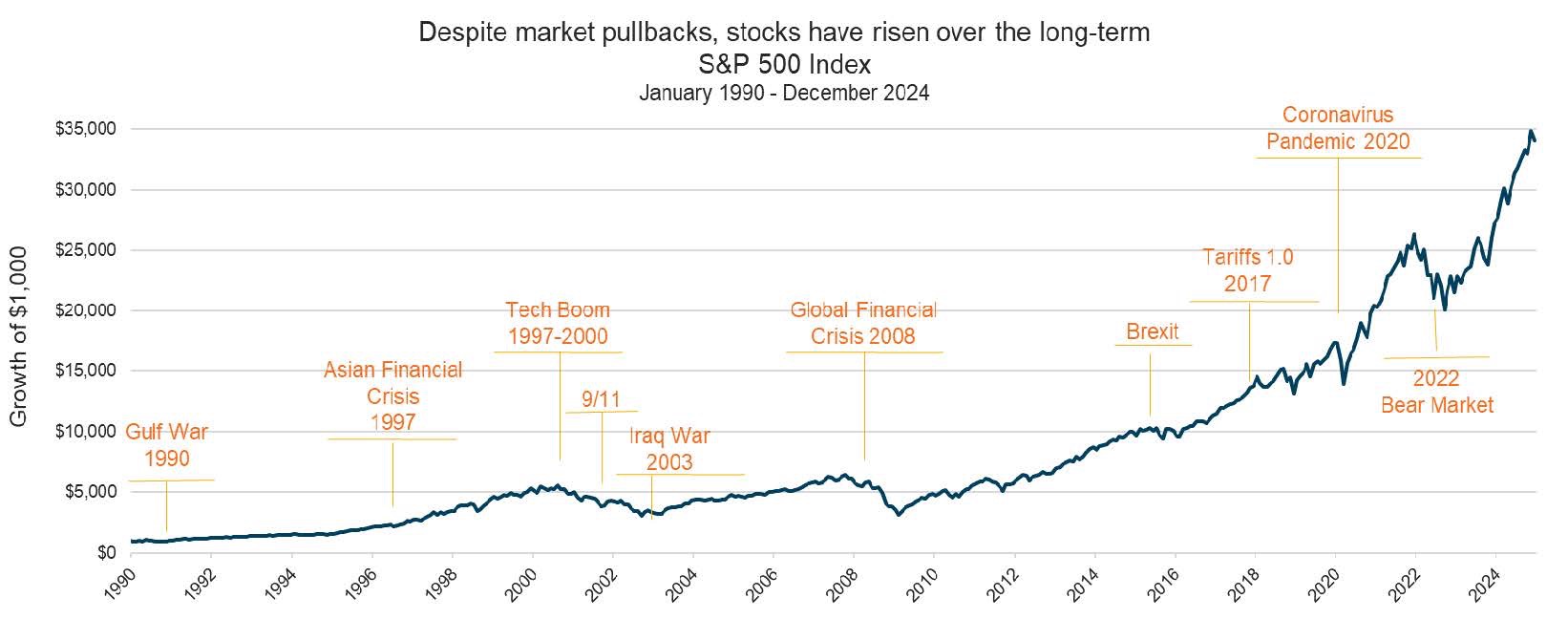
1.Keep perspective. Market sell-offs are painful but sadly normal. History shows stocks have recovered and delivered long-term gains. Since 1928, on average, the S&P 500 has experienced three 5% corrections per year, a10% decline once a year, a 15% decline every two years,and a 20% or more decline (i.e., a significant bear market) every three years. The reasons for market declines have varied from geopolitical risk, political uncertainty, recession worries, inflation concerns, etc. Yet, investors in stocks who have focused on the long term have seen an average annual return of 10.6% since 1990, and 74% of those years ended with positive returns. There is a saying that stock markets climb a wall of worries, and sadly, there is no shortage of things to worry about today.
SOURCE: FactSet
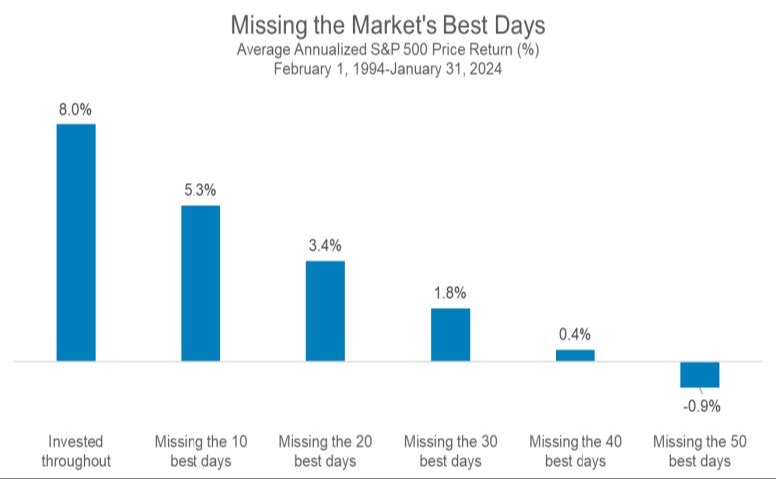
2.Focus on time in the markets rather than trying totime them. Since market pullbacks are frequent, avoiding them could potentially seem to improve investment results. However, attempts to avoid pullbacks more often lead to missing out on significant advances. One reason is that market volatility is often clustered. Big moves in the market, both up and down, occur within days of each other, making it difficult to avoid only the bad. Staying the course may require extra Pepto Bismol, but in the end, it may be healthier for your portfolio. That being said, you know that part of the TruVectr FormulaTM that I employ for you is a multi layered approach to investing according to your plan, goals and needs. So you are not invested "in the market" as defined by a random formula. Your portfolio is specific, tailored and managed.
Source: Bloomberg
3.Control what you can control. Market volatility isimpossible to control, but that does not mean doing nothing. Investors can partner with their financial advisors to revisit their financial goals and evaluate their portfolio mix, cash flow needs, and risk tolerance. They can also consider adding defensive assets like cash or high-quality bonds to stabilize their portfolios. Lastly, in our process we help you build your financial plan using the TruVectr FormulaTM, from the base of the pyramid up. Remember to first look at Your Plan when assessing markets and short term news cycles.
Investing carries an inherent element of risk and it is possible to lose money. Past performance does not guarantee future results.